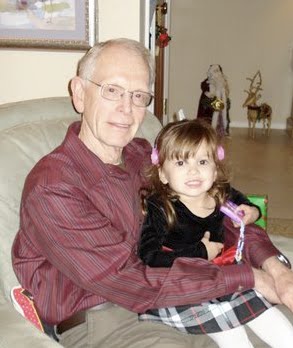
My dad, Jerry, wrote to me about a conversation he had with a friend of his who is dying. Dad said that the conversation felt “unsatisfying,” that he may have made his friend feel worse. The trouble with death is we can’t fix it. I remember when the family guinea pig died. My mom and stepdad were out of town and I was taking care of my much younger half siblings. They watched as I dug a hole in the front yard to lay the little furry squealer. My sister (about age 4) was crying as I lowered it into the hole, but my brother (age 2) was angry. “Don’t put it in there. Wait until Daddy gets home. He’ll fix it!”
In my reply to my Dad, I wrote that I can't imagine what it's like to be losing a friend and trying to find the right words. But, I continued, in my minimal experience with death, it seems like people always want to find the right things to say when the best thing we can do is to listen and be present with what they are telling us. I remember when my dad’s mother, Margo (or Nonnie as we all called her), was nearing the end of her life. She said: "Everyone seems to want to tell me what I'm going through when I'm the one dying." Maybe I was afraid to hear what she'd say. Fear gets in our way. Death is a solitary, often lonely, process it seems, but we can learn from each other's experience of it. So maybe just my dad taking the time to be on the phone with his friend was enough.
When my stepdad, Phil, was facing death, deteriorating from Multisystem Atrophy (MSA), he seemed so resigned and lost in a way. One day I was sitting next to him on the bed watching TV and he said that he had dreamed he died the night before. I asked him what it was like and he said: "It wasn't so bad!" and then he laughed. I couldn’t believe we were laughing about something so grave. But, I learned that to keep our senses of humor even in the face of death is the way to go.
I am fascinated by death and how people die in peace - or not. For an assignment for my Masters in counseling program, I interviewed a chaplain at our local hospice. He said that he helps people find meaning, which helps regrets take a back seat. He said he listens to their stories and then points out how they contributed to the world and to others' lives. As a counselor, though, we primarily work with the grieving families so I’m not sure I will move in that direction. I want the chaplain's job!
One of my favorite books is A Year to Live by Stephen Levine. He says: “In whatever condition and conditioning we find ourselves, whether we have just won the lottery or discovered we have only a year to live, there is a basic, even essential, gratitude contemplation that is always appropriate…It acknowledges the enormous opportunity of being alive and awakening to our true nature.” Every page of that book is precious and I am moved no matter how many times I read it. Essentially, when loved ones around us are dying we are given, again, the gift of life and an opportunity to deepen our relationships to self and others and to appreciate this day, this moment in these dear bodies. And when it comes to their experience of transitioning from this planet, all we can do is listen and bravely follow their cues.
Showing posts with label Multisystem Atrophy. Show all posts
Monday, July 4, 2011
Life and Death
Labels:
chaplain,
death,
hospice,
Multisystem Atrophy,
Stephen Levine
Saturday, June 25, 2011
The Doing and Being of Fame
Yesterday an author told me that when he interviews family members of a famous individual, they are considered “sources” and it is not “kosher” to pay sources for interviews and access to all of the tapes, letters, records and photos. I countered that family members are the people responsible for preserving the memory and name of the renowned individual. Is it “kosher” to feed off of another individual's fame? Ethics always trumps technicalities, no matter the field. Family members know that person intimately and would be happy to "collaborate." Any other information from a distant source is hearsay. If the family has limited resources – or even if they don’t – it is honorable and customary to compensate them for collaboration on a project that creates history. On the other hand, as a writer, I know that authors don't devote years to a project unless they have a sincere interest in a story. And if they want to make big bucks, they probably wouldn't have chosen writing as a career.
My stepfather, Phil Hill, was famous. I remember acting as his “protector” (hardly a body guard) at an event at Laguna Seca where he was signing autographs. He had not yet been diagnosed with MSA (Multisystem Atrophy), but likely was ill because he tired easily and needed breaks. My job was to cut off the line when he needed an extended break. I let one guy cut in line because he was an enthusiastic and educated fan who was about to cry. Good Lord, man, pull it together! Another man asked if I would be so kind as to sign his program instead. He was thrilled and left me at the back of the line scratching my head in wonder. Another man became belligerent and refused to leave. He glared at me and pushed out his chest. He was joined by the vulture I witnessed at every event who collected as many signatures as possible and made his living feeding off the fame of others. Someday he would cash in on the posters and photos. Repeat visitors were welcomed if they had a sincere interest in Phil’s history, but objectification is disgusting no matter what form it takes. But who am I to judge? Maybe the guy waits in long lines for signatures because he enjoys the others around him. Maybe he educates fans about the history of the racers he doggedly pursues.
What does this have to do Doing and Being? Fame is a burden, but the passion that made Phil famous was not. Emotionally, he supported my bliss (dance) 100% because he could see that it lit me up and gave me meaning and a reason for being. Regrettably, Phil never wrote an autobiography – to tell his story as close to the truth as possible, but to him what mattered was the intensity of the moment: telling a great story and telling it well. He knew how to masterfully dole out details that led to a climax that had everyone in awe or stitches (depending) by the end. He loved music and Christmas and the smell of a garage. He loved Planet Earth, Animal Planet, his cats and Formula 1 at 3 a.m. He loved caviar, Italian proscuitto (anything Italian or English) and George Latour’s private reserve cabernet. The reason people enjoyed basking in Phil's presence is because he knew not only how to DO but how to BE. He lived moments fully and deeply as if they were his last. He was one of the most authentic people you would ever have met. Whereas many famous folk master a “Scheiss Freundlich” attitude, Phil had no interest in wearing a persona. What you saw was what you got.
Why is it that someone who knew how to tell a great story never told his own? I think he trusted the visually gripping and aesthetically appealing photos he took and later published in collections, which includes a book he was in the midst of finishing when he died. He trusted his friends from Road and Track to recount memories. He trusted his son, Derek, who is making a documentary, and his daughter, Vanessa, who has a far broader involvement in the car world than I do. He knows that they will tell the truth because they understood the private, classy while INTENSE man he was. I knew Phil not as a racer or car collector, but as a father figure. He was deeply kind, tender, generous, intelligent and terribly, wonderfully funny. While he understood the underbelly of humankind, he chose to focus on the light – especially in his last years. It will be interesting to see what is written about him, but based on how he lived, I think he decided that the only real truth we will ever have is in the moment. The rest is a result of confabulation, imagination and longing.
My stepfather, Phil Hill, was famous. I remember acting as his “protector” (hardly a body guard) at an event at Laguna Seca where he was signing autographs. He had not yet been diagnosed with MSA (Multisystem Atrophy), but likely was ill because he tired easily and needed breaks. My job was to cut off the line when he needed an extended break. I let one guy cut in line because he was an enthusiastic and educated fan who was about to cry. Good Lord, man, pull it together! Another man asked if I would be so kind as to sign his program instead. He was thrilled and left me at the back of the line scratching my head in wonder. Another man became belligerent and refused to leave. He glared at me and pushed out his chest. He was joined by the vulture I witnessed at every event who collected as many signatures as possible and made his living feeding off the fame of others. Someday he would cash in on the posters and photos. Repeat visitors were welcomed if they had a sincere interest in Phil’s history, but objectification is disgusting no matter what form it takes. But who am I to judge? Maybe the guy waits in long lines for signatures because he enjoys the others around him. Maybe he educates fans about the history of the racers he doggedly pursues.
What does this have to do Doing and Being? Fame is a burden, but the passion that made Phil famous was not. Emotionally, he supported my bliss (dance) 100% because he could see that it lit me up and gave me meaning and a reason for being. Regrettably, Phil never wrote an autobiography – to tell his story as close to the truth as possible, but to him what mattered was the intensity of the moment: telling a great story and telling it well. He knew how to masterfully dole out details that led to a climax that had everyone in awe or stitches (depending) by the end. He loved music and Christmas and the smell of a garage. He loved Planet Earth, Animal Planet, his cats and Formula 1 at 3 a.m. He loved caviar, Italian proscuitto (anything Italian or English) and George Latour’s private reserve cabernet. The reason people enjoyed basking in Phil's presence is because he knew not only how to DO but how to BE. He lived moments fully and deeply as if they were his last. He was one of the most authentic people you would ever have met. Whereas many famous folk master a “Scheiss Freundlich” attitude, Phil had no interest in wearing a persona. What you saw was what you got.
Why is it that someone who knew how to tell a great story never told his own? I think he trusted the visually gripping and aesthetically appealing photos he took and later published in collections, which includes a book he was in the midst of finishing when he died. He trusted his friends from Road and Track to recount memories. He trusted his son, Derek, who is making a documentary, and his daughter, Vanessa, who has a far broader involvement in the car world than I do. He knows that they will tell the truth because they understood the private, classy while INTENSE man he was. I knew Phil not as a racer or car collector, but as a father figure. He was deeply kind, tender, generous, intelligent and terribly, wonderfully funny. While he understood the underbelly of humankind, he chose to focus on the light – especially in his last years. It will be interesting to see what is written about him, but based on how he lived, I think he decided that the only real truth we will ever have is in the moment. The rest is a result of confabulation, imagination and longing.
Subscribe to:
Posts (Atom)


